Amusement Park vs Theme Park vs Water Park: What’s the Difference?
Amusement parks, theme parks and water parks are often used interchangeably, but they are actually different types of entertainment destinations. The biggest difference is the type of experience they are designed to provide.
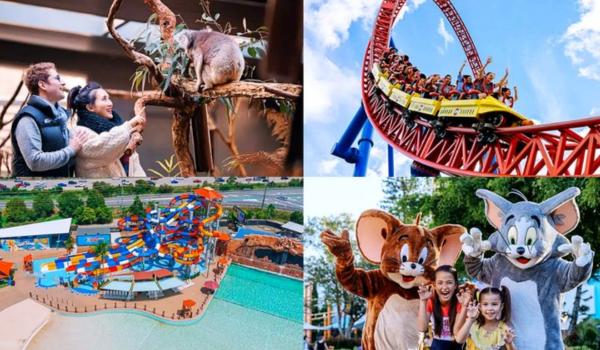
An amusement park primarily focuses on rides, games and general entertainment. A theme park takes the concept further by creating a complete themed environment around stories, characters, cultures or fictional worlds. A water park focuses mainly on water-based attractions such as slides, wave pools and splash zones.
In India, the distinction is particularly useful for investors because the choice affects land requirements, construction costs, seasonality, equipment, target customers and revenue opportunities.
Quick Difference: Amusement Park vs Theme Park vs Water Park
| Factor | Amusement Park | Theme Park | Water Park |
| Main attraction | Rides & entertainment | Themed experiences | Water attractions |
| Theme requirement | Usually limited | Core part of the park | Optional |
| Major attractions | Ferris wheel, rides, coasters, games | Themed rides, shows, characters | Slides, wave pools, lazy rivers |
| Water facilities | May have some | May have some | Essential |
| Storytelling | Limited | Very important | Usually limited |
| Construction complexity | Moderate–High | High | Moderate–High |
| Seasonality in India | Moderate | Moderate | High in many regions |
| Family appeal | High | Very high | Very high |
| Typical revenue | Tickets, F&B, games, merchandise | Tickets, F&B, merchandise, experiences | Tickets, F&B, lockers, cabanas, merchandise |
| Best suited for | General entertainment | Immersive destination experience | Summer & family recreation |
What Is an Amusement Park?
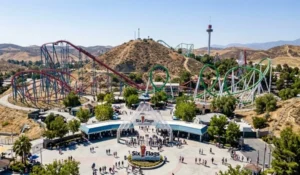
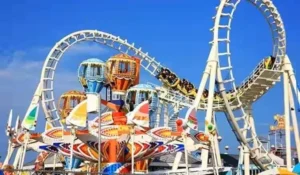
An amusement park is a recreational destination primarily built around rides, attractions, games and entertainment.
Typical attractions include:
- Roller coasters
- Ferris wheels
- Merry-go-rounds
- Bumper cars
- Drop towers
- Family rides
- Children’s rides
- Arcade games
- Live entertainment
- Food courts
- Merchandise shops
Indian development regulations can classify amusement parks broadly around recreational facilities such as giant wheels, roller coasters, merry-go-rounds, swimming pools and similar rides, along with supporting facilities such as food outlets, shops and rest areas.
Example
Imagine a park where visitors come mainly to enjoy:
Thrill rides + family rides + children’s rides + games + food.
That is primarily an amusement park.
Business model
The major revenue sources are generally:
- Entry tickets
- Food and beverages
- Games
- Merchandise
- Parking
- Premium rides/experiences
- Events and group bookings
For India’s broader amusement and theme park industry, ticketing remains the largest revenue stream, accounting for roughly 70–75% according to ImagicaaWorld’s FY2024–25 industry assessment.
What Is a Theme Park?
A theme park is an amusement destination where rides and attractions are organized around one or more specific themes.
The theme can be based on:
- Movies
- Fictional characters
- History
- Fantasy
- Adventure
- Space
- Wildlife
- Indian mythology
- Different countries or cultures
- Future technology
The important point is that the theme becomes part of the visitor experience.
Instead of simply seeing a roller coaster, visitors might enter a fictional world where:
- Buildings follow a particular architectural style
- Rides tell stories
- Employees wear character costumes
- Restaurants follow the theme
- Music and lighting match the environment
- Characters interact with visitors
- Merchandise relates to the theme
Amusement Park vs Theme Park: The Main Difference
The easiest way to understand the difference is:
An amusement park sells rides. A theme park sells an experience built around a theme.
There can obviously be overlap.
A theme park contains amusement rides, but its attractions are connected through a larger concept.
For example, ImagicaaWorld Entertainment Limited operates a destination combining themed attractions, rides, shows, characters, dining and retail. Its Imagicaa destination includes both a Theme Park and Water Park.
This shows that the three categories are not always completely separate in the real world.
What Is a Water Park?
A water park is a recreational destination where the majority of attractions involve water.
Common attractions include:
- Water slides
- Wave pools
- Lazy rivers
- Splash zones
- Kids’ water play areas
- Mat racers
- Body slides
- Tube slides
- Family raft rides
- Activity pools
For example, Imagicaa’s Water Park includes water slides, a wave pool and mat racers.
Unlike a traditional amusement park, the central attraction isn’t a mechanical ride such as a roller coaster. It is the water-based experience.
Why Are Water Parks Popular in India?
India’s climate makes water-based recreation particularly attractive.
Water parks can be especially popular during:
- Summer holidays
- School vacations
- Weekends
- Public holidays
- Family trips
Historical industry analysis has also noted that India’s market has been relatively more water-park-led than many global markets, partly because of India’s climate and consumer preference for water-based recreation.
However, water parks can face greater weather-related seasonality than indoor or conventional amusement attractions.
Major Difference in Attractions
Amusement Park
The attraction mix may include:
Roller coaster → Ferris wheel → Bumper cars → Drop tower → Family rides
Theme Park
The attraction mix may be:
Themed land → Story-based ride → Character experience → Live show → Themed restaurant → Merchandise
Water Park
The attraction mix may be:
Wave pool → Water slide → Lazy river → Kids’ splash zone → Raft ride
Difference in Land Requirements
Land requirements vary enormously depending on the project.
Industry estimates cited in ImagicaaWorld’s FY2024–25 annual report classify large parks as generally exceeding 40 acres, medium parks at 10–40 acres and small parks below 10 acres. These are indicative industry averages, not mandatory legal requirements.
Amusement Park
Land is required for:
- Rides
- Paths
- Landscaping
- Restaurants
- Parking
- Service areas
- Buildings
Theme Park
A theme park can require more land because different themed zones may need to be developed.
For example:
Fantasy Zone + Adventure Zone + Children’s Zone + Food Street + Shows + Rides
Water Park
Water parks require significant space for:
- Pools
- Slides
- Pump houses
- Filtration systems
- Changing rooms
- Lockers
- Landscaping
- Restaurants
- Parking
Therefore, land size should be determined by the planned visitor capacity and attraction mix rather than simply choosing a fixed acreage.
Difference in Construction Cost
There is no single universal cost for any of these three formats.
Cost depends on:
- Land price
- Park size
- Number of rides
- Ride quality
- Civil construction
- Theming
- Pools
- Water-treatment systems
- Landscaping
- Buildings
- Parking
- Utilities
- Safety systems
- Technology
Generally:
Basic Amusement Park → Lower complexity
Theme Park → Higher theming and attraction investment
Water Park → High pool, slide and water-infrastructure investment
An integrated destination combining all three can require substantially more capital.
For reference, industry data cited by ImagicaaWorld places indicative capex for large parks above ₹400 crore, medium parks at ₹100–400 crore and small parks below ₹100 crore. These figures represent industry averages and can vary substantially by project.
Which Has Better Profit Potential?
There is no automatic winner.
Profitability depends on:
Visitors × Average Revenue Per Visitor − Operating Costs
For example, a smaller amusement park with lower land and operating costs may generate a better return on investment than a massive theme park with expensive construction and financing.
Amusement Park
Potential advantages:
- Multiple ride categories
- Broad audience
- More flexible attraction mix
- Potentially easier to operate than a heavily themed destination
Theme Park
Potential advantages:
- Strong branding
- Premium pricing potential
- Merchandise opportunities
- Storytelling and repeat-visit potential
- Tourism appeal
Water Park
Potential advantages:
- Strong summer demand
- Popular family attraction
- High-capacity water attractions
- Food, locker and cabana opportunities
But water parks can also experience stronger seasonality.
Revenue Sources Compared
| Revenue Source | Amusement Park | Theme Park | Water Park |
| Entry tickets | ✓ | ✓ | ✓ |
| Food & beverages | ✓ | ✓ | ✓ |
| Merchandise | ✓ | ✓✓ | ✓ |
| Character merchandise | Sometimes | ✓✓ | Rare |
| Premium experiences | ✓ | ✓✓ | ✓ |
| Parking | ✓ | ✓ | ✓ |
| Events | ✓ | ✓ | ✓ |
| Hotels | Optional | Common for large destinations | Optional |
| Cabana rental | Rare | Sometimes | ✓ |
| Lockers | Sometimes | Sometimes | ✓ |
| Water activities | Limited | Optional | ✓✓ |
A major destination can combine several of these revenue streams. The industry is also increasingly focusing on non-ticket revenue such as hotels, retail and food & beverage.
Safety Requirements
Safety is important for all three formats, but the specific risks differ.
For amusement rides, Indian development regulations reference IS 15475 Parts 1–6 for amusement ride safety. These standards cover areas related to ride safety, design, erection, operator training, operation, maintenance and performance testing.
Amusement Park
Key concerns include:
- Mechanical ride safety
- Structural integrity
- Operator training
- Emergency procedures
- Crowd management
Theme Park
It has the same ride-safety requirements plus:
- Themed structures
- Special effects
- Character interactions
- Show equipment
- Complex guest movement
Water Park
Additional concerns include:
- Water quality
- Pool safety
- Slip-and-fall prevention
- Slide safety
- Lifeguards
- Water-treatment systems
- Emergency rescue procedures
Therefore, a water park isn’t simply an amusement park with swimming pools added to it.
Seasonality Comparison
Seasonality is another major difference.
| Park Type | Seasonality |
| Amusement Park | Medium |
| Theme Park | Low–Medium if designed as a destination |
| Water Park | High in many Indian markets |
A water park may see very strong summer demand but weaker visitation during colder or rainy periods.
A theme park can potentially reduce seasonality by offering:
- Indoor attractions
- Shows
- Restaurants
- Retail
- Hotels
- Festivals
- Seasonal events
This is one reason integrated entertainment destinations are becoming increasingly common.
Which Park Is Best for Business?
There is no universal answer.
Choose an Amusement Park if:
You want:
- General family entertainment
- Multiple ride categories
- Flexible attraction planning
- A relatively straightforward concept
Choose a Theme Park if:
You want:
- A premium destination
- Strong branding
- Storytelling
- Character-based experiences
- Tourism-driven visitation
- Merchandise opportunities
Choose a Water Park if:
You want:
- Summer-focused entertainment
- Water attractions
- Family recreation
- Strong seasonal demand
- Slide and pool-based experiences
Choose an Integrated Park if:
You have substantial capital and a suitable location.
An integrated destination can combine:
Theme Park + Water Park + Hotel + Food + Retail + Events
Imagicaa is a practical Indian example of this integrated approach: its destination includes a Theme Park, Water Park, hotel and other entertainment experiences across a 130+ acre site.
Amusement Park vs Theme Park vs Water Park: Final Comparison
If we simplify everything into one sentence:
Amusement Park = Rides
Theme Park = Rides + Story/Theme
Water Park = Water Attractions
And an integrated destination can combine all three.
For an entrepreneur, however, the decision should not be based only on which concept sounds attractive. The project should be evaluated against:
- Target customers
- Location
- Land availability
- Investment capacity
- Competition
- Climate
- Tourism
- Expected annual visitors
- Average revenue per visitor
- Operating and maintenance costs
- Seasonality
- Regulatory and safety requirements
India’s amusement and theme park industry was estimated at ₹108–114 billion in FY2024 and is projected in the cited industry assessment to grow at around 9–11% CAGR through FY2030. The industry also includes amusement parks, theme parks and indoor entertainment centres, with expansion increasingly moving beyond traditional metros into Tier-2 and Tier-3 markets.
Final Takeaway
There is no single “best” park format.
If your goal is rides and general entertainment, choose an amusement park.
If your goal is immersive experiences and destination tourism, consider a theme park.
If your goal is water-based family recreation, a water park may be the better fit.
And if you have the capital, land and market demand, an integrated amusement + theme + water park destination can create multiple revenue streams and reduce dependence on a single attraction category.
The most important decision is therefore not simply “Which park is better?”
It is:
Which park concept best matches the location, customers, investment budget and long-term business model?
Business Park Group — Exploring Parks, Business & Opportunities.